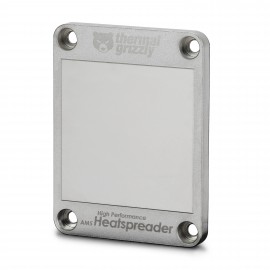

Details
Thermal Grizzly's Intel High Performance Heatspreader V1 (HPHS) is an upgrade heatspreader for delidded Intel 12th Gen, 13th Gen and 14th Gen processors. It replaces the ILM and heatspreader, so it is only for delidded CPUs! On AM5? The AMD version is here.
Properties
- Socket manufacturer
- Intel, delidded CPUs only
- Material
- Nickel-plated copper
- Color
- Silver nickel-plated
- Surface area
- 207% larger than the stock IHS
- Size
- 70 x 53 x 5.7 mm
- Weight
- 103 g, 136 g boxed
A larger, diamond-milled surface
The heatspreader is made from nickel-plated copper and has a diamond milled precision surface that is 207 percent larger than the one on the original heatspreader. Thermal Grizzly says this increased surface area, compared to the Integrated Heatspreader (IHS) from Intel, enables maximum heat dissipation for air and water coolers. It stays compatible with both, while the precision milling ensures extremely low surface roughness for the best contact with the heat sink. The Integrated Loading Mechanism (ILM) of the mainboard comes off as well. According to the data sheet, that spreads the contact pressure of the CPU in the socket evenly.
In Thermal Grizzly's internal test, an Intel Core i5-14600K ran Cinebench R23 at 5.6 GHz and 1.4 V in a custom loop with an Alphacool Core 1 water block. The radiator was a Watercool MO-RA3 with four Noctua 200 mm fans. With the standard IHS and a contact frame the average was 92.1 °C, and with this heatspreader it was 77.3 °C. Thermal Grizzly calls those guide values: results depend on the individual processor, the room temperature and the cooling system used.
Thermal paste and liquid metal
Traditional thermal pastes and gallium-based liquid metals are both compatible with the nickel-plated surface. The nickel forms a barrier layer between the liquid metal and the copper cooler, so that liquid metal does not diffuse into the copper and alloy formation is minimized. This means, Thermal Grizzly says, that multiple applications of liquid metal are generally not necessary. For the best possible temperatures under load it recommends liquid metal, such as Conductonaut, as the thermal interface material (TIM) between the CPU die and the HPHS. Between the HPHS and the cooler, thermal paste, thermal pads or liquid metal can be used.
Note on the use of KryoSheet and mono blocks
The HPHS has been extensively tested internally by Thermal Grizzly in various application scenarios. During development, great emphasis was placed on stable operation of the processor and RAM. In its test series, KryoSheet in combination with the HPHS was unable to achieve any significant improvements in terms of temperature and was problematic in terms of contact pressure. For this reason, Thermal Grizzly states: "we cannot recommend the use of thermal pads". That is because their additional thickness has a strong influence on the contact pressure and can therefore impair the function. Its product page adds that the excessive mounting pressure can cause operational issues, which may include incorrect memory detection or memory instability.
The internal contour of the HPHS is optimized for a very thin layer of liquid metal, and the HPHS rests directly on the CPU package (PCB). With Kapton Insulation Sheets there is a risk that the HPHS rests on the sheet and the CPU die does not make contact. To insulate the electronic components, the page asks for a thin layer of TG Shield.
When using mono blocks for the mainboard, the mounting height and thermal pads may need to be adjusted. It is important to check whether there is contact between the HPHS and the mono block. If you have any questions, please contact Thermal Grizzly support at any time.
Compatibility note
The HPHS is compatible with the following processors, and a CPU compatibility list is available online:
- Intel 12th Gen CPUs
- Intel 13th Gen CPUs
- Intel 14th Gen CPUs
Thermal Grizzly verified these by internal tests and considers processors that are not listed incompatible. For delidding, our store stocks the Intel Delid-Die-Mate for 13th and 14th Gen.
Attention: Loss of warranty
- Removing the heatspreader ("delidding") of a processor is at your own risk!
- The manufacturer's warranty expires when the CPU is delidded, and damage caused by delidding the CPU is not covered by it.
- Removing the ILM may also invalidate the manufacturer's warranty of the mainboard manufacturer.
In the box
- 1x Intel heatspreader
- 4x pan-head screws, UNC thread 3/8"
- 1x hexagon socket wrench 5/64"
- 1x angle wrench Torx T20
Thermal Grizzly's data sheet and compatibility list are both PDFs.