
Details
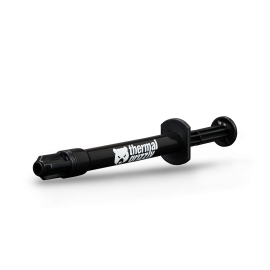
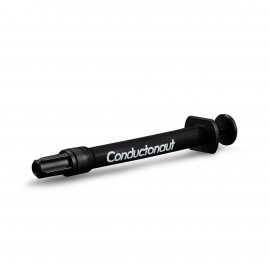
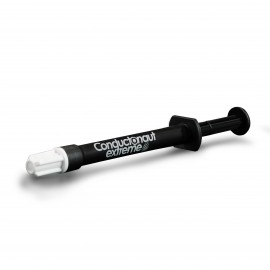
Thermal Grizzly Conductonaut Extreme is a gallium-based liquid metal thermal compound for CPUs, GPUs, notebooks and ICs, here in the 1g size. It is available in 1g or 5g syringes: the 5g is here, and so is the standard Conductonaut it is the further development of.
Properties
- Amount
- 1g syringe
- Alloy
- Gallium and indium
- Electrically insulating
- No
- Operating temperature
- -50°C to +200°C
- Viscosity
- 0.0021 Pa⋅s
- Color and density
- Silver, 6.29g/cm³
What changed from Conductonaut
It was developed for applications with maximum power density. The metallic alloy stays liquid at room temperature, allowing for the minimum possible layer thickness. Where the standard product also contains tin, this one consists exclusively of gallium and indium. According to Thermal Grizzly's data sheet, dispensing with the other alloying components raised the thermal conductivity by approx. 18 % over the standard product (the sheet gives no test setup for the figure), and the increased material compatibility means that no tin interactions can occur. Thermal Grizzly sums it up as optimized thermal conductivity compared to conventional liquid metal.
Liquid metal vs. thermal paste
Technically this is not a thermal paste, even where it is called one: a paste consists of liquid and solid particles, and the solid particles are its disadvantage. The surfaces of the CPU heat spreader and of the base plate of the CPU cooler are uneven on a microscopic level. A traditional thermal paste fills these irregularities unevenly, since its solid particles are larger than the gaps caused by the unevenness, so more distance must be filled between the cooler and the heat spreader. A heat-conducting medium in the form of liquid metal does not have this problem because it does not contain any "large" particles, and as a result the two surfaces sit closer together. At the same time liquid metal has a constant heat transfer, while in pastes the larger solid particles usually conduct heat better than the paste parts around them. Thermal Grizzly's conclusion: liquid metal is preferable to thermal paste, especially in high energy applications.
Surfaces it works on
It is recommended as a high-end product for experienced users who are looking for a solution with the best heat dissipation in the temperature range above 8°C. We recommend applying it on nickel-plated copper, as this offers the best long-term stability (gallium is slightly corrosive towards other metals); for best long-term performance that means heatsinks with nickel-plated copper bases. It must not be used with aluminum coolers: do not bring it into contact with aluminum at all.
Conductive, and it marks the surface
Attention: the alloy is electrically conductive. Thermal Grizzly's Shield coating protects against liquid metal and short circuits. Note that the metal may also leave optical residues. If it diffuses into the heatspreader, the engraved information may become illegible, and there is a risk that the manufacturer's warranty will be invalidated.
Applying it
The scope of delivery covers the whole job. Clean the CPU and the cooler with a cleaning pad so both are dry and free of residue. Apply a pinhead-sized amount to each and spread it with the cotton swabs, then mount the cooler. Application is at its optimum due to the metal needle, which doses finely, and the plastic needle draws excess back into the syringe. If the syringe got cold in storage or transport, warm it to at least 25 °C first.
Production and quality
Thermal Grizzly describes the liquid metal as manufactured "to the highest quality standards at our production site in Germany". Its expertly trained staff continuously monitor the entire production chain. From testing the purity of the raw material, through the production of the liquid metal and filling, to packaging, every step is subject to multiple quality controls.
In the box
- 1x syringe with 1g of liquid metal
- 1x metal needle for application
- 1x plastic needle for absorbing
- 2x lint-free industrial cotton swabs
- 2x cleaning pads
Thermal Grizzly's data sheet and quick start guide are both PDFs.