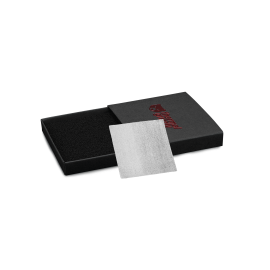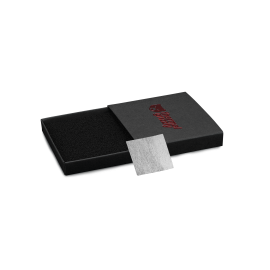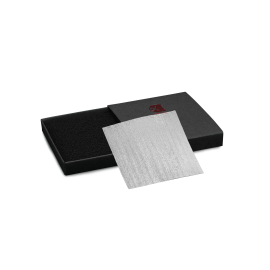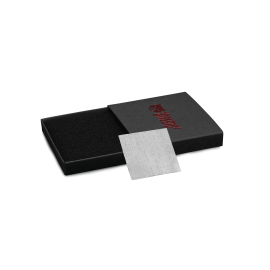

Details
Thermal Grizzly's KryoSheet graphene thermal pad at 44 x 37 mm and 0.2 mm thick. Thermal Grizzly lists this size for the Nvidia RTX 5090 and for Intel socket 1851 CPUs. For the RTX 5080 or socket AM5 it lists the 33 x 33 mm pad.
Properties
- Size
- 44 x 37 mm
- Thickness
- 0.2 mm
- Material
- Graphene
- Electrically insulating
- No
- Operating temperature
- -250°C to +150°C
- Color
- Anthracite
A graphene pad in place of paste
The pads of the KryoSheet series can stand in for thermal compounds (thermal pastes) from the higher performance segment, as an excellent alternative in Thermal Grizzly's words. Similar to Carbonaut pads, they have a conformable surface with very high thermal conductivity. This is the high-end product of the two, and compared to Carbonaut Thermal Grizzly says it offers significantly higher thermal conductivity. The increased conductivity is due not only to the choice of material, but also to what it calls an innovative manufacturing process. The pad does not contain any liquid components and therefore is not subject to normal aging, as is the case with traditional thermal paste. Drying out is not possible. Thermal Grizzly sums it up in four points: outstanding thermal conductivity, easy to use, consistently high performance and extreme durability.
How the graphene is structured
The graphene pads have a molecular structure stacked in the Z-direction, and it is this optimized structure that enables their constant thermal conductivity. It comes from a specially developed manufacturing process. In it, the hexagonal crystal structure of the graphite is broken up along the basal plane in order to exploit the anisotropy of the graphite's thermal conductivity. However, that complex process has a side effect: the electrical conductivity is also increased and the stability of the pads is affected. Attention: the pad is electrically conductive, so it should only be used according to Thermal Grizzly's instructions and kept out of contact with electrical components. Follow the instructions!
Made for the RTX 5090
This size is specifically designed for use on the GB202-300-A1 graphics chip of the NVIDIA GeForce RTX 5090, and it comes with a Kapton Insulation Sheet. Before the pad goes on, that sheet is applied around the chip, on the surrounding electronic components (SMDs). It serves to protect the chip's surroundings by insulating those components from contact with the electrically conductive pad. More information is available in the blog post about this size on Thermal Grizzly's website.
Size and compatibility
KryoSheet is available pre-assembled, meaning cut to size, in various CPU/GPU standard sizes. Thermal Grizzly's compatibility list for the 44 x 37 mm pad:
- Nvidia GPUs: RTX 5090
- Intel CPUs: Socket 1851
Thermal Grizzly's advice is to buy the pad in a size minimally larger than the area to be covered. For a desktop CPU (AMD AM4, Intel 1700) with a heat spreader (IHS) of about 37 x 37 mm, that means the 38 x 38 mm pad.
Fitting it
Clean the contact surfaces (CPU and CPU cooler, or GPU and GPU cooler), position the pad on the processor or graphics chip to be cooled, then mount the cooler. Note that multiple use of KryoSheet is not recommended. When dismantling the cooler and handling the pad after use, microcracks may occur in the structure of the graphene, which may impair performance.
Between a CPU die and a High Performance Heatspreader (HPHS), or under a Direct-Die cooler, thermal sheets such as Carbonaut and KryoSheet may see insufficient mounting pressure and reduced heat dissipation. For those two cases Thermal Grizzly explicitly recommends liquid metal, e.g. Conductonaut, between the die and the cooler or HPHS.
Who it is for
Because the pad does not have to be replaced at regular intervals like thermal paste, Thermal Grizzly calls it maintenance-free. The application areas of Carbonaut and KryoSheet overlap strongly. The largest one we stock is the Carbonaut in 51 x 68 mm.
In the box
- 1x KryoSheet pad, 44 x 37 x 0.2 mm
- Kapton Insulation Sheet
Thermal Grizzly's data sheet, size guide and safety data sheet are all PDFs.