
Details
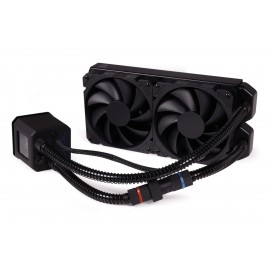
The Alphacool Eisbaer Aurora 360 CPU - Digital RGB V1.1 is an AIO liquid cooler with a 360 mm copper radiator for AMD AM4, AM5 and TR4 and Intel LGA 1200, 1700 and 1851. The complete socket list is below. It arrives prefilled, can be refilled through a fill port and can be expanded via quick-release fasteners. The 240 mm cooler of the series is the Eisbaer Aurora 240 CPU - Digital RGB.
Properties
- Intel sockets
- LGA 1150, 1151, 1155, 1156, 1200, 1700, 1851, 2011, 2011-3, 2066, 755
- AMD sockets
- AM2, AM2+, AM3, AM3+, AM4, AM5, FM1, FM2, FM2+, sTRX4, TR4
- Radiator
- 360 mm, 397 x 124 x 30 mm, copper
- Fans in the box
- Rise Aurora 120 mm, 0 - 2500 RPM
- Pump
- DC-LT, 2600 RPM
- Tubes
- TPV, expandable by quick release
Fit
The compatibility list above is the one on Alphacool's product page. The box holds one set of AMD mountings, one set of Intel mountings and one backplate. The manual assigns the backplate to Intel 1156 / 1155 / 1151 / 1150 / 1200 / 1700 / 1851, and its own screws to Intel 2011 / 2011-3 / 2066. On AMD AM4, AM3+, AM3, AM2+ and AM2 the cooler mounts on the original backplate of the mainboard. For TR4 the manual shows a separate TR4 mounting set, which the data sheet's scope of delivery does not name. A mounting kit for 2011-3 Narrow ILM (Art. Nr.: 12531) is available separately, according to the manual.
Before mounting, the manual has you remove the protective film from the cooling plate, clean any remaining thermal paste off the CPU and spread a pea-sized blob of paste into an even, thin layer. Tighten the screws crosswise and hand-tight, without tools. The window of the cooler faces upwards so that the pump does not run dry, and the radiator sits above the cooler.
The heart of the cooler is the cooler including the pump
Alphacool presents the Eisbaer Aurora CPU AIO water cooler as a worthy successor to the well-known Eisbaer series that improves many details of the water cooling. Its cooler base is made of copper and has a fine slit structure. Compared to the previous model the surface has been enlarged, in order to fully cover the larger DIE areas of the AMD and Intel processors. The DC-LT pump has also been redesigned, and Alphacool says it is now around 10% more powerful while being even quieter. Alphacool makes the expansion tank many times larger than that of standard AIO systems, and says this ensures a longer service life. There is also a fill port on the cooler unit, so you can refill liquid through it if necessary. Alphacool calls that especially important if you want to expand the circuit using the quick-release fasteners.
DIY components everywhere
Alphacool names expandability as a major advantage of the Eisbaer Aurora series. It comes via the so-called Eisbaer-Ready quick-release fasteners, which have also been redesigned and are now smoother and less conspicuous than those of the previous model. Nevertheless, Alphacool states that these quick-release fasteners are 100% compatible with all Eisbaer Ready products. Its examples are products such as pre-filled radiators and the Eiswolf AIO water cooler for graphics cards (GPU). The well-known, separately available Alphacool HF quick-release fasteners for standard DIY water cooling systems are on that list too. The connectors, or fittings, are from Alphacool's Enterprise Solution series. With their standard G1/4 thread they can be swapped for any other connector. The TPV hose, which Alphacool calls extremely durable, is also used in the Enterprise Solution series for servers and workstations.
Copper Radiator
The radiators are made of copper, as is usual with Alphacool. The company describes itself as the first manufacturer in the world to use copper for all water-carrying components. Those are the pre-chambers, the cooling fins and the cooling channels to which the fins are soldered. Only the connection threads are made of brass, for hardening reasons. The cooling fins are also only very lightly varnished, and if you look closely the copper even shines through. Alphacool gives the cooling performance as the reason for this: it would be reduced by an overly thick varnish.
The fin density is at 15 FPI, which Alphacool calls optimal. This means that the radiator works perfectly even at low airflow, in its words. Too high a density would require higher-speed fans, and a lower fin density would no longer benefit from faster-speed fans. Here, Alphacool says, it has chosen the happy medium.
Fans and lighting
The entire cooler is equipped with addressable digital RGB LEDs, and the number in the pump housing is 10. That housing has an Eisbaer pattern all around that is fully illuminated, which Alphacool says creates a real eye-catcher in the case. The Alphacool Rise Aurora 120 mm fans are also fully illuminated, with 5V aRGB LEDs. Their fan frame has a unique pattern with many small cutouts that create what Alphacool calls a particularly elegant effect. You can't see any individual LEDs, making the lighting much more interesting than a simple LED ring in Alphacool's view. Of course, all of the digital RGB LEDs can be controlled as desired, and almost any effect is possible depending on the controller.
How to connect everything
How is everything connected? The cooler is a closed, prefilled system with its tubes mounted, so it needs no fittings. The pre-installed quick-release fastener is where the loop opens for expansion. The manual notes that 2-3 drops of water can escape when unscrewing it, which is normal.
As usual, the fans are controlled via a 4-pin PWM connector. A matching Y-cable is included so that you don't have to connect all of the fans individually to the motherboard. The RGB lighting is connected via a 3-pin JST connector, and each cable also has an integrated Y-adapter, making it very easy to connect the fans together. The packaging also holds a 3-pin 5V adapter, which is included for the mainboard. This allows you to connect and control the fans on any motherboard with the appropriate connector, and the manual warns never to use a 12V RGB header for it. Alternatively, the digital RGB controller from the box can also be used. The pump on the cooler uses a 3-pin Molex connector. This can also be connected to the motherboard, or to the supplied controller as the manual shows.
Technical data radiator
| L x W x H | 397 x 124 x 30 mm |
| Material | full copper (solid copper) |
| Threads (connections) | 2x G1/4 |
| Max working temperature | 60 °C |
| Pressure tested | 0.8 bar |
Technical data pump housing
| L x W x H | 66 x 66 x 69 mm |
| Material reservoir (expansion tank) | transparent nylon |
| Threads (connections) | 2x G1/4 |
| Connection Digital aRGB | 3-Pin JST + 3-Pin 5V |
| Quantity Digital aRGB LED | 10 |
Technical data pump
| Speed | 2600 RPM |
| Voltage (tension) | 6-13.5V DC |
| Power consumption | 3.2 W |
| Maximum flow rate | 72 L/h |
| Maximum head (delivery head) | 1 m |
Technical data fans
| Speed | 0 - 2500 RPM (+/- 10%) |
| Static pressure | 3.17 mm H2O |
| Air flow rate | 118.9 m³/h |
| Volume max | max. 31.5 dB(A) |
| Fan connector | 4-Pin PWM |
| Connection Digital aRGB | 3-Pin JST + 3-Pin 5V |
Notes
- Use only clear, transparent water cooling fluids. Alphacool warns that the particles and additives in pastel liquids can clog and permanently damage radiators, pumps, coolers and hoses, which can void the manufacturer's warranty.
- The manual says topping up is normally not necessary, and advises checking the water level after expanding the circuit. For topping up it recommends Alphacool's own clear coolants (CKC or Eiswasser Crystal, no UV) or pure distilled or osmosis filtered water.
- If the pump is unusually loud at first start, the manual blames air bubbles from transport and suggests tipping the case back and forth a little. After around 12 hours of operation the air should be gone.
In the box
- 1x Alphacool Eisbaer Aurora 360 CPU cooler (radiator, fan & cooler)
- 12x M3x5 screws
- 12x M3x30 screws
- 1x thermal paste
- 4x springs
- 4x 0.5 mm washers
- 4x 2 mm washers
- 4x nuts
- 1x Y-adapter 4-pin PWM
- 1x digital-RGB controller
- 1x digital-RGB adapter
- 1x set AMD mountings
- 1x set Intel mountings
- 1x backplate
Alphacool's MANUAL and data sheet are both PDFs.